
| New Mex Canada Inc. |
|
|
|
A new regulation will require health and safety awareness training for every worker and supervisor under Ontario’s Occupational Health and Safety Act (OHSA). The regulation comes into force July 1, 2014.
Workers can use this free training program as one way to meet the minimum training required by the Occupational Health and Safety Awareness and Training regulation: Here is why it is important that all guards be interlocked or locked (requiring a key or tool to open)...
Follow this link  While the CE mark is certainly helpful in bringing a piece of equipment to Canada, it does not mean that the equipment is compliant with Canadian (or US) Codes for electrical safety or machine guarding.
The following document from the Electrical Safety Authority explains this: Bulletin 2-7-29 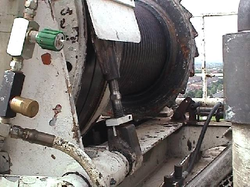 The Ministry of Labour has placed a great deal of emphasis on the electrical and mechanical problems that plague Ontario's aging fleet of tower cranes. While the Regulations are (more) clear on the need for structural inspection, the requirement to inspect the health of the electrical controls and critical mechanical components (brakes, gearboxes, bearings, reeving systems, etc.) is often left to the Operator on a quick visual inspection.
One recent example of an alert from the M.L.I.T.S.D. is shown HERE. The MOL tasked Professional Engineers Ontario to come up with a more comprehensive Standard for the inspection of tower cranes. This Standard is currently in development: PEO Standard For Tower Crane Inspection CCP Engineering can put together a comprehensive tower crane inspection plan or just add an electrical/mechanical inspection component to your existing plan. Fortunately or unfortunately, depending on how you look at it, the Act and Regulations place a great deal of importance on making the protection fool-proof. One of the reasons for that is the Ontario court of Appeal case of R. v.. Dofasco Inc. (2007) 87 O.R. (3d) 161 at paragraph 24: “Workplace safety regulations are not designed for the prudent worker. They are intended to prevent workplace accidents that arise when workers make mistakes, are careless, or are even reckless. In our view, this principle also extends to deliberate acts of employees while performing their work.”
Follow this link to read a very interesting article by Mr. Norm Keith of Gowling, Lafleur, Henderson LLP on the implications that this decision has had. In simple terms, Employers used to be able to get non-licensed engineers to do professional engineering work, as long as it was for their internal purposes (not directly to the public) and did not fall under one of the mandated requirements for a P.Eng.
This 'industrial exemption' was repealed under subsection 5(17) of Schedule 2 to the Open for Business Act, 2010 and section 12(3)(a) of the Professional Engineers Act (the “industrial exception”). The intent was to ensure that professional engineers will become more involved in everyday design, especially where health & safety is involved. However, due to political pressure, the Ontario Government extended the date of implementation (originally to September 1, 2013 and then indefinitely). Link to info on PEO website A Pre-Start Health & Safety Review (PSR or PSHSR) is a machine safety compliance review for equipment or processes being installed or modified in a manufacturing environment, prior to its commissioning at the final user’s location in Ontario. A PSR is required in Ontario by Section 7 of Regulation 851 of the Occupational Health and Safety Act (S.7 of O.Reg. 851), under 8 specific circumstances, to be performed by an Ontario Licensed Professional Engineer. The review is typically done at the final manufacturing location, however a preliminary review at the machine manufacturer’s location, before installation, can be advantageous as changes or modifications are more easily fabricated and integrated.
The Pre-Start Health & Safety Review includes a written report detailing measures necessary to bring the machine or process into compliance with applicable standards. The report typically contains a risk and hazard analysis as prescribed in CSA Standards. Recommendations can include minimum design parameters such as safety circuit schematic revisions, component suggestions and conceptual sketches of physical guarding modifications required to achieve compliance to the Act and its regulations plus applicable sections of electrical and/or machine guarding standards. The following items are examples requiring a Pre-Start Review, based on the list of 8 circumstances in the Regulation:
|
|
OFFICE ADDRESS:
CCP Engineering Inc. 50 Steeles Ave. East, Unit 9, Milton, Ontario L9T 4W9 Canada |
MAILING ADDRESS:
CCP Engineering Inc. 160 Luella Crescent, Brampton, Ontario L7A 3H8 Canada |

|

|

|

|
© CCP Engineering Inc.